SEO has always lived in a gray area.
Not because it’s unethical by nature—but because it sits at the intersection of human behavior, technology, and business pressure. And whenever money, visibility, and competition collide, lines start to blur.
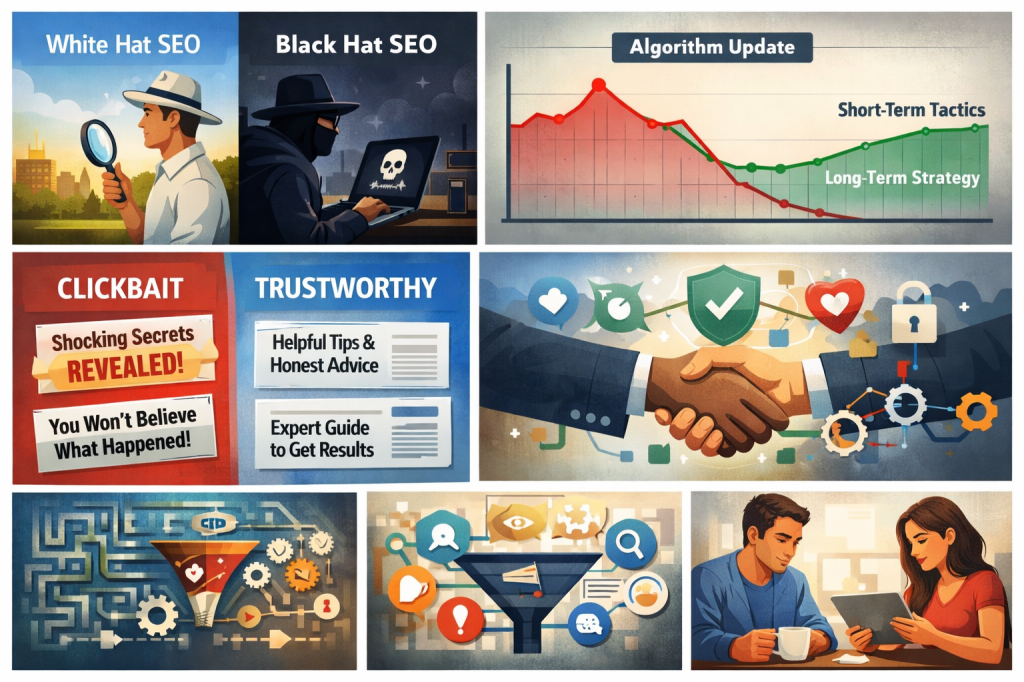
At its best, SEO helps people find what they’re already looking for.
At its worst, it tricks them into clicking things they never wanted.
And most of the internet lives somewhere in between.
This article isn’t about pointing fingers.
It’s about asking a question the industry avoids:
At what point does optimization stop serving users—and start manipulating them?
SEO Didn’t Start as a Manipulation Game
In its early days, SEO was simple.
Make useful content.
Describe it clearly.
Help search engines understand what it’s about.
That was it.
But as rankings became revenue—and traffic became power—SEO shifted from clarity to competition. Suddenly, visibility felt scarce. Everyone wanted page one. And shortcuts became tempting.
The goal quietly changed from:
“Help the right people find the right information”
to:
“Win the algorithm—by any means necessary.”
That’s where ethics entered the conversation, whether we acknowledged it or not.
Why Black-Hat SEO Exists (And Always Will)
Let’s be honest: black-hat tactics didn’t appear because people are evil.
They appeared because:
- Algorithms reward results
- Clients demand fast wins
- Competition feels ruthless
- Fear of invisibility is real
When someone promises:
“Rank in 30 days”
“Guaranteed page-one placement”
“Secret loopholes Google doesn’t want you to know”
They’re not selling strategy.
They’re selling relief from anxiety.
And that’s exactly why these tactics keep resurfacing.
The Slippery Slope: From Optimization to Manipulation
Here’s the uncomfortable truth:
Most unethical SEO doesn’t start unethical.
It starts slightly dishonest.
A keyword stuffed “just a little.”
A backlink from a site you didn’t check too closely.
A headline that promises more than the article delivers.
Individually, these feel harmless.
Collectively, they erode trust.
Manipulation happens when:
- You optimize for bots at the expense of humans
- You exploit loopholes knowing they’ll close
- You manufacture signals instead of earning them
- You create content designed to rank, not help
The danger isn’t just penalties.
It’s reputational decay.
Algorithm Loopholes Are Not Strategy
There’s a difference between understanding algorithms and exploiting them.
Ethical SEO asks:
“How do we align with how search engines want to serve users?”
Manipulative SEO asks:
“How do we game this before it stops working?”
Loophole-driven strategies are built on borrowed time. They work—until they don’t. And when they collapse, they take everything with them: rankings, traffic, credibility.
Ethical SEO compounds.
Manipulative SEO resets to zero—sometimes overnight.
Why Google Keeps “Changing the Rules”
Many people complain that algorithms are unfair.
That Google “moves the goalposts.”
But here’s the reality:
Search engines evolve because manipulation forces them to.
Every major update is a reaction to abuse:
- Content farms
- Link schemes
- AI spam floods
- Thin affiliate pages
- Fake authority signals
Algorithms aren’t punishing ethics.
They’re chasing authentic usefulness.
If your strategy collapses after every update, that’s not bad luck—it’s a warning sign.
The Human Cost of Unethical SEO
We rarely talk about this part.
Unethical SEO doesn’t just hurt rankings.
It hurts people.
It:
- Misinforms users
- Wastes time
- Exploits fear and urgency
- Pushes bad advice higher than good advice
- Prioritizes clicks over consequences
When health, finance, parenting, or mental health content is manipulated for traffic, the damage isn’t theoretical—it’s real.
Ethics in SEO isn’t abstract.
It’s personal.
Why Ethical SEO Is Now a Business Necessity
Here’s the shift many businesses haven’t fully realized:
Trust is now the currency of the internet.
People are:
- More skeptical
- More informed
- More sensitive to manipulation
- Faster to leave
- Less forgiving of bait-and-switch tactics
Brands that rely on trickery don’t just lose rankings—they lose loyalty.
Ethical SEO builds:
- Brand equity
- Long-term visibility
- Audience trust
- Referral traffic
- Sustainable growth
It doesn’t spike as fast.
But it doesn’t crash either.
Ethical SEO Is Harder—And That’s the Point
Manipulation feels easier because it avoids the hard parts:
- Understanding user intent deeply
- Creating genuinely helpful content
- Earning links instead of buying them
- Playing the long game
- Accepting slower growth
Ethical SEO requires patience.
It demands restraint.
It forces honesty.
But it also creates something rare online:
credibility that survives change.
The Question Every SEO Should Ask
Before publishing, before optimizing, before chasing a tactic—ask this:
“If a real person trusted this content, would I feel proud?”
Not “Will this rank?”
Not “Can we get away with this?”
But:
“Does this deserve attention?”
That single question draws a clear line between optimization and manipulation.
The Future of SEO Is Quietly Ethical
The loudest tactics burn out first.
The sneakiest tricks get exposed.
The cleverest hacks become obsolete.
What remains is content that:
- Helps without deceiving
- Optimizes without exploiting
- Converts without coercing
- Educates without exaggerating
Ethical SEO isn’t boring.
It’s resilient.
And resilience is what survives algorithms, trends, and time.
Final Thought: Visibility Without Integrity Is Fragile
You can trick an algorithm.
You can’t trick an audience forever.
SEO done without ethics is like building on sand—impressive until the tide comes in.
But SEO done with integrity?
That builds something that lasts.
And in today’s internet, lasting trust is the highest ranking of all.
 GIML PUBLISHING
Leave a comment